Every one is familiar with the difficulties that frequently arise over the giving of change, and how the assistance of a third person with a few coins in his pocket will sometimes help us to set the matter right. Here is an example. An Englishman went into a shop in New York and bought goods at a cost of thirty-four cents. The only money he had was a dollar, a three-cent piece, and a two-cent piece. The tradesman had only a half-dollar and a quarter-dollar. But another customer happened to be present, and when asked to help produced two dimes, a five-cent piece, a two-cent piece, and a one-cent piece. How did the tradesman manage to give change? For the benefit of those readers who are not familiar with the American coinage, it is only necessary to say that a dollar is a hundred cents and a dime ten cents. A puzzle of this kind should rarely cause any difficulty if attacked in a proper manner.
Wednesday, February 23, 2011


Tuesday, February 8, 2011
THE PUZZLING MONEY-BOXES
Four brothers—named John, William, Charles, and Thomas—had each a money-box. The boxes were all given to them on the same day, and they at once put what money they had into them; only, as the boxes were not very large, they first changed the money into as few coins as possible. After they had done this, they told one another how much money they had saved, and it was found that if John had had 2s. more in his box than at present, if William had had 2s. less, if Charles had had twice as much, and if Thomas had had half as much, they would all have had exactly the same amount.
Now, when I add that all four boxes together contained 45s., and that there were only six coins in all in them, it becomes an entertaining puzzle to discover just what coins were in each box.
Wednesday, January 26, 2011
The Ruby Brooch
The annals of Scotland Yard contain some remarkable cases of jewel robberies, but one of the most perplexing was the theft of Lady Littlewood's rubies. There have, of course, been many greater robberies in point of value, but few so artfully conceived. Lady Littlewood, of Romley Manor, had a beautiful but rather eccentric heirloom in the form of a ruby brooch. While staying at her town house early in the eighties she took the jewel to a shop in Brompton for some slight repairs.
"A fine collection of rubies, madam," said the shopkeeper, to whom her ladyship was a stranger.
"Yes," she replied; "but curiously enough I have never actually counted them. My mother once pointed out to me that if you start from the centre and count up one line, along the outside and down the next line, there are always eight rubies. So I should always know if a stone were missing."

Six months later a brother of Lady Littlewood's, who had returned from his regiment in India, noticed that his sister was wearing the ruby brooch one night at a county ball, and on their return home asked to look at it more closely. He immediately detected the fact that four of the stones were gone.
"How can that possibly be?" said Lady Littlewood. "If you count up one line from the centre, along the edge, and down the next line, in any direction, there are always eight stones. This was always so and is so now. How, therefore, would it be possible to remove a stone without my detecting it?"
"Nothing could be simpler," replied the brother. "I know the brooch well. It originally contained forty-five stones, and there are now only forty-one. Somebody has stolen four rubies, and then reset as small a number of the others as possible in such a way that there shall always be eight in any of the directions you have mentioned."
There was not the slightest doubt that the Brompton jeweller was the thief, and the matter was placed in the hands of the police. But the man was wanted for other robberies, and had left the neighbourhood some time before. To this day he has never been found.
The interesting little point that at first baffled the police, and which forms the subject of our puzzle, is this: How were the forty-five rubies originally arranged on the brooch? The illustration shows exactly how the forty-one were arranged after it came back from the jeweller; but although they count eight correctly in any of the directions mentioned, there are four stones missing.
Wednesday, January 19, 2011
THE WIDOW'S LEGACY
A gentleman who recently died left the sum of £8,000 to be divided among his widow, five sons, and four daughters. He directed that every son should receive three times as much as a daughter, and that every daughter should have twice as much as their mother. What was the widow's share?
Solution
Friday, December 17, 2010
A Chessboard Fallacy

"Here is a diagram of a chessboard," he said. "You see there are sixty-four squares—eight by eight. Now I draw a straight line from the top left-hand corner, where the first and second squares meet, to the bottom right-hand corner. I cut along this line with the scissors, slide up the piece that I have marked B, and then clip off the little corner C by a cut along the first upright line. This little piece will exactly fit into its place at the top, and we now have an oblong with seven squares on one side and nine squares on the other. There are, therefore, now only sixty-three squares, because seven multiplied by nine makes sixty-three. Where on earth does that lost square go to? I have tried over and over again to catch the little beggar, but he always eludes me. For the life of me I cannot discover where he hides himself."
"It seems to be like the other old chessboard fallacy, and perhaps the explanation is the same," said Reginald—"that the pieces do not exactly fit."
"But they do fit," said Uncle John. "Try it, and you will see."
Later in the evening Reginald and George, were seen in a corner with their heads together, trying to catch that elusive little square, and it is only fair to record that before they retired for the night they succeeded in securing their prey, though some others of the company failed to see it when captured. Can the reader solve the little mystery?
Solution
Friday, November 12, 2010
The Spanish Dungeon
Not fifty miles from Cadiz stood in the middle ages a castle, all traces of which have for centuries disappeared. Among other interesting features, this castle contained a particularly unpleasant dungeon divided into sixteen cells, all communicating with one another, as shown in the illustration.
Now, the governor was a merry wight, and very fond of puzzles withal. One day he went to the dungeon and said to the prisoners, "By my halidame!" (or its equivalent in Spanish) "you shall all be set free if you can solve this puzzle. You must so arrange yourselves in the sixteen cells that the numbers on your backs shall form a magic square in which every column, every row, and each of the two diagonals shall add up the same. Only remember this: that in no case may two of you ever be together in the same cell."
One of the prisoners, after working at the problem for two or three days, with a piece of chalk, undertook to obtain the liberty of himself and his fellow-prisoners if they would follow his directions and move through the doorway from cell to cell in the order in which he should call out their numbers.

Solution
Sunday, October 10, 2010
The Two Rooks
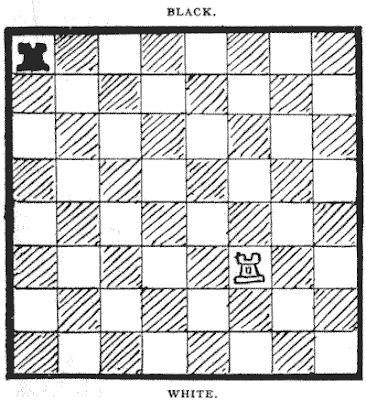
This is a puzzle game for two players. Each player has a single rook. The first player places his rook on any square of the board that he may choose to select, and then the second player does the same. They now play in turn, the point of each play being to capture the opponent's rook. But in this game you cannot play through a line of attack without being captured. That is to say, if in the diagram it is Black's turn to play, he cannot move his rook to his king's knight's square, or to his king's rook's square, because he would enter the "line of fire" when passing his king's bishop's square. For the same reason he cannot move to his queen's rook's seventh or eighth squares. Now, the game can never end in a draw. Sooner or later one of the rooks must fall, unless, of course, both players commit the absurdity of not trying to win. The trick of winning is ridiculously simple when you know it. Can you solve the puzzle?
Solution

Solution
Subscribe to:
Posts (Atom)


